


Over the last few months I have spent three days a week working at Seisen-Ryo, KEEP's hotel side of the operation. Seisen-Ryo was originally built in the 1930s as a leadership camp for young Japanese Christians to come and relax in the mountains. Today, it has evolved into a relaxing resort retreat that is well-known around Japan--mainly because of its association with the infamous soft cream. The whole Seisen-Ryo property is made up of the "Original Lodge"--built in 1957 after the first building burned down, the "New Annex" which was constructed in 2009, and then the surrounding Cottages. Guests can enjoy the old world charm of the Western and Japanese style rooms in the Original Lodge, the new amenities offered in the New Lodge's Western or Japanese style suites or stay in the Cottages in the woods with their larger groups (as you can tell, one of my jobs was to work on the wording for translated marketing materials).
GM--our name for our general manager of Seisen-Ryo and the Paul Rusch Memorial Museum--had tasked me with working at the hotel at both the front desk and in the kitchen of the restaurant. I wasn't quite sure what I was going to be doing at first, all he told me was I was to be there to speak English with everyone and to get them accustomed to working with foreigners.
My first task working at the front desk was to collaborate with Hoshii-san, my manager while there, to translate signs around the hotel. She has really great English, so she would tell me what the Japanese sign said and then I would translate it into native and natural English. She told me it was a task that they had been slowly working on over the last few years, but would just fall to the wayside as more important tasks arose. We went around the entire property and translated anything and everything we could find. There were signs warning of the slippery bridge ahead, giving guests directions on how to rent items, where people that aren't guests should please refrain from entering, where to wait in line for check-in/check-out, etc. That was the easy part, wherever there was a Japanese sign, we put it into English. The harder part was going through and deciding what needed to be explained to foreigners that Japanese people don't even think twice about. Hoshii-san had me stay in the hotel as a guest in the Japanese style room and really analyze what, as a foreign guest, I didn't understand. Just as an example, the idea of bathing in the hot springs is second nature to the Japanese, but as a timid foreign guest, the proper procedures are something that needed to be explained.
.JPG) |
| Just one example of the MANY translated signs around the hotel. |
.JPG) |
| Working with guests at the front desk. |
 |
| Hoshii-san also translated everything for the table of contents so everything is easily found! |
 |
| English is so complicated when you sit down and think about it! |
 |
| Plating dessert. |
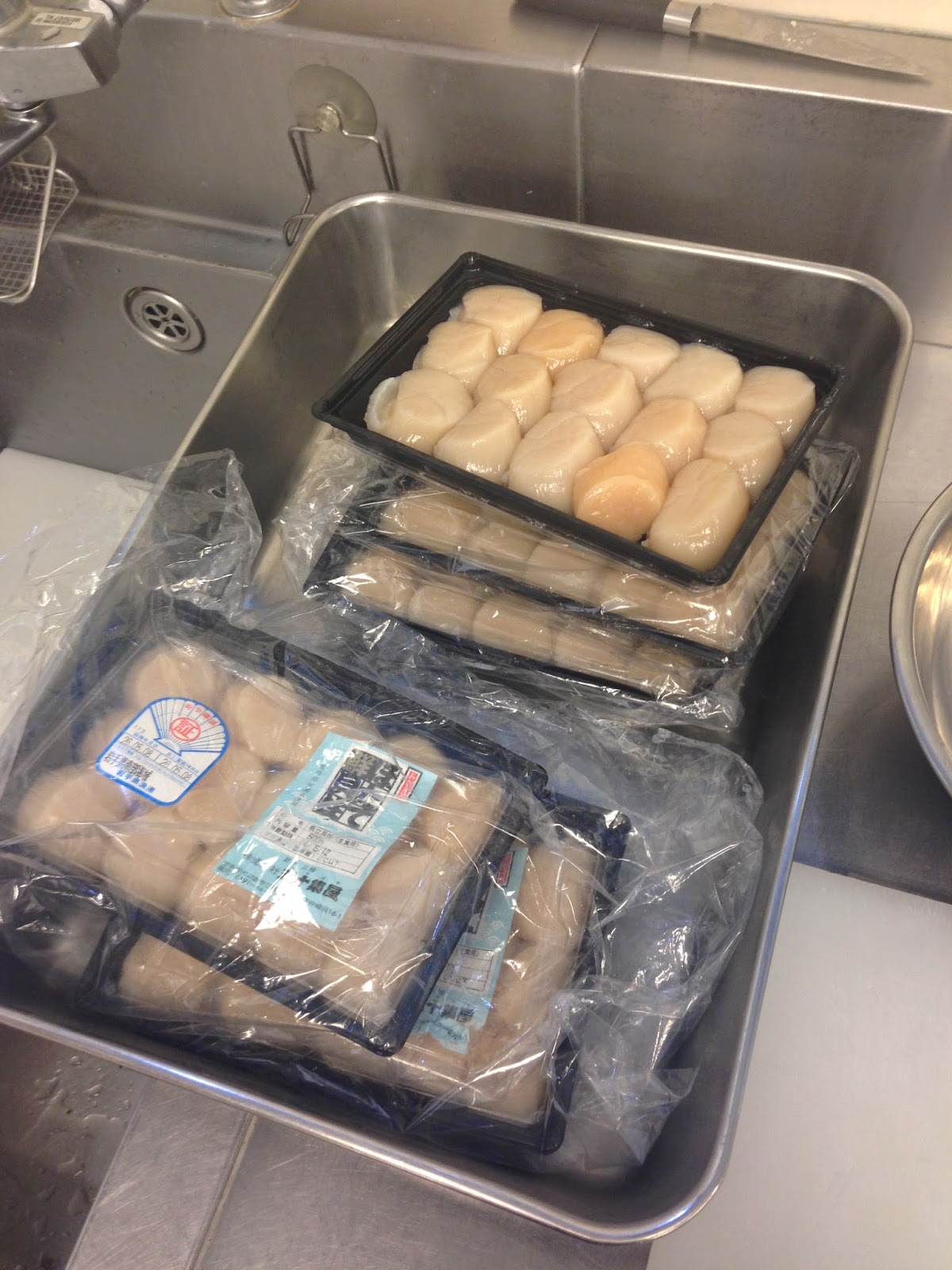 |
| They trusted me to work with scallops one day. |
 |
| Watching Japanese chefs work with fish is mesmerizing. |
 |
| Making a raspberry mouse--gelatin comes in sheet form in Japan, not powder. |
 |
| Stirring up the mousse! |
 |
| Kaori, the pastry chef, measuring out bacon for a savory creme-brulee. |
Until next time,
Charlotte


