Showing posts with label Seisen-Ryo. Show all posts

Wednesday, November 12, 2014

My First Experience in Kimono

     As I mentioned in one of my previous posts, Seisen-Ryo sets up a traditional tea ceremony in the lobby for guests about once a month. I have participated a few times, but mostly as just a guest enjoying the traditional green tea, never one serving. Well this time I was told I needed to get the FULL experience and be on the other side of the tea--in full kimono. The ladies from the office that put this on brought so many kimonos for me to choose from. I of course chose the pink because obviously it was the girliest. I also learned that the darker kimonos are meant for the older ladies and it would be inappropriate for me to wear anything but a bright color because I am so young and single, which was represented by the sleeve length of the kimono. The longer sleeve shows that you are married, while the shorter sleeve means you're single and ready to mingle.
Shameless selfie!


They said I was really good at the "kimono shuffle".
     Dressing in kimono is no easy feat. It is not some sundress you throw on and run out the door. This is about a ten step process. Now I am by no means the average size of a Japanese woman, I am closer in relation to Godzilla than these women that were dressing me. The first step is to put on the little white slip part to act as the undergarments of the kimono. Next comes the really fun part! The look you are working towards in a kimono is pretty much a rectangle. A kimono is absolutely not meant to give you feminine curves, so you start building this box around your waist. There were probably five different layers wrapped around my waist. Lest we not forget the rope that goes around your thighs to keep the kimono folded over and from dragging on the floor. Between my height and very much western hour glass shape--these poor women had their work cut out for them dressing me. The were impressed I fit in the tiny shoes though. I'm guessing they probably thought my feet were going to be massive, too.
Finished product--only just a smidge short in every possible way.
     I only spent two hours in kimono serving tea and while, yes you feel pretty glamorous in it, finally getting to take it off and unwrap all the layers can only be explained as feeling like taking off those high heels at the end of the night and finally getting to put your feet up, everything having felt squished and now it's all free!  
The decoration for fall with coordinating poem.
That little grey pocket square there in my kimono is like a little napkin to serve with. If you want to learn more about the process, or get a refresher, here's the link to an older post where I first learned about how to make traditional green tea.
All of my tea master teachers on the right (notice their darker kimonos?) and then Sandi, a board member of the American Committee for KEEP, next to me and Jennifer with the American Committee for KEEP office next to her.
Tea Master Charlotte.


     Komatsu-san, in the reddish kimono in the group photo, was generous enough to give me my own kimono! She says it used to one of her daughters. I'm now official! It's a beautiful orange ombre that I can't wait to wear for the next tea ceremony when I get back--hopefully my ribs will be back in place by then. I highly recommend trying out true, traditional kimono if you ever are in Japan and get the chance!


                Until next time,
                                    Charlotte

Wednesday, July 9, 2014

Who Would Have Thought Barbecues Would Be So Big Here?

     
     As the busy season at KEEP approaches, each department likes to have a little party and celebrate with some fun before the real work starts. In true Japanese fashion, they have taken the American barbecue tradition and made it their own! Since I work within so many different departments, I was fed well during this season. When you think barbecue, you think hamburgers and hot dogs and potato salad, right? Not in Japan! This is time to break out the flat top and grill up some yakisoba noodles and kobe beef! The one thing that remains that does translate of course are the libations that are involved when work people get together off the clock.

     The first barbecue I got invited to was for Seisen-Ryo, the hotel here. Now the guys manning the grill weren't just some guy from accounting that thinks he is a grill master because he has a grill set at home he got for Father's Day. No, these were the people from the professional kitchen at Seisen-Ryo that were cooking up our food. Nary a burnt hamburger in sight, we feasted on some of the best 'barbecue' food I have ever eaten! The party went well into the night and after a few drink we all got to talking casually about things and of course people wanted to practice English with me. This was the first time I really felt at home here in Japan.


One of the front desk staff starting up the yakisoba.

The staff from the kitchen cooking up the most tender, melt in your mouth meat I have ever had. 

Not your every day hot dog--heavy duty, stick to your bones sausage over here.

Local Kiyosato sake--the bottle is now a flower vase in my room.
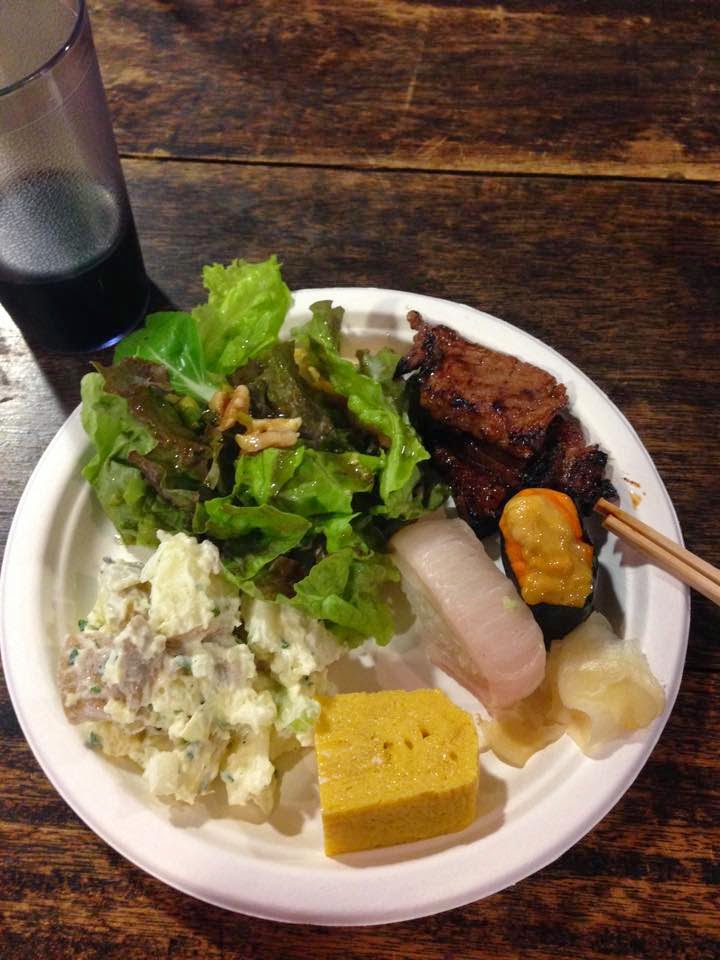
     In the international relations department, since there are so many American interns, we wanted to show our Japanese coworkers and the other interns from France what an American barbecue looked like. The provided us with sushi and we showed them things we either missed from home or we thought were musts at a cookout. The day also coincided with probably my favorite Japanese holiday tanabata--or the star festival. The story goes that tanabata

"celebrates the meeting of the deities Orihime and Hikoboshi (represented by the stars Vega and Altair respectively).The Milky Way separates these lovers, and they are allowed to meet only once a year on the seventh day of the seventh lunar month of the lunisolar calendar". 

Pretty romantic concept if you ask me. One of the customs for this holiday is to write wishes on strips of paper and to hang them from bamboo trees. You can see these trees all around the city, even the local grocery store and J-Mart. This year it rained on the holiday, so not only did we have our cookout inside, but legend has it the star crossed deities couldn't meet this year. Tough break--there's always next year, right?
Obi-chan manning the grill. We told them we MUST have corn on the cob--of course we didn't have it dripping in butter. We couldn't go full American.
Of course there must also be sushi, right? My first time trying uni, or sea urchin. Japan finally presented me with a food I am not a fan of.
Jonathan, one of the interns from France, with our wine and potato salad and guacamole in the back. The idea that a food item is used to bring another food item to your mouth just blew everyone's mind. "I take this chip, pick up some of this green stuff, and then eat all of it?!"
Talk about fusion food.


Gon-san, Zack, Jaimah and me preparing our tanabata wishes.
Putting my wish on the tree!
I know my wish will come true--it already is!
The best wish by far came from Kazu-san.
     I am a firm believer that food transcends all language barriers. You don't need words when "mmmm" works just fine.

Until next time, 

         Charlotte


Saturday, May 31, 2014

Tea Ceremony and Story Time at Seisen-Ryo

    
     So I know one of my main purposes here is to provide international exchange and share what I know and teach about my culture, but sometimes I am the one that gets to learn and those are some of my favorite days! Not only do I get to break the monotony of the work day, but I get to try something new.

     During the busy season at KEEP, Seisen-Ryo will cater to their guests by setting up a casual tea ceremony in the lobby. I say casual in the sense that guests can check-in and stop by for a quick cup of green tea before heading to their room. By no means is the setup itself casual. A few of the ladies that work in the different departments of KEEP are traditional tea masters and they so graciously showed me how to prepare a proper cup of green tea.  A lot more than you would think goes into this ritual which is best explained in pictures.
Sign inviting guests to come in an have a cup of tea.
It's all about the bamboo brush to get the tea nice and frothy.
First, I got to play the guest. You're first a served a sweet to coat your palate and prepare it for the bitterness of the tea to come.
Enjoying my cookie.
Receiving my cup of tea. Much different than a tea cup. The whole display of the tea ceremony coordinates with the season. The flowers there are to represent summer.
Now it is my turn to learn! The big ladle there is to scoop out the hot water into the tea bowl to wash it out, which you then pour into the decorative vase there. Then you use your special cloth to wipe out the bowl in a specific way, making the shape of one of the Japanese hiragana characters (like making the shape of an A). Next, you put two of the tiny spoonfuls there of the green tea into the bowl and then ladle more hot water in, then you mix it up with the bamboo brush there to make it all frothy. And voila! Proper green tea.
Frothing up the tea!
My first guests!
     Seisen-Ryo doesn't like to forget about the kids during the busy season! One of the women I work with, Hoshii-san, used to be a teacher before she came to Seisen Ryo. She has a whole stash of children's books under her desk and she puts on story time a few times a month during the summer. I got to be the special guest reader for this last time. The kids come after dinner, right before bed and we set up a story corner. This time Hoshii-san read from one of her HUGE Japanese books first.
Story time with special guest Charlotte File from America!
Large group this night.
     The Very Hungry Caterpillar is a very popular book here in Japan amongst children just like back in the States which was a nice surprise seeing as it was one of my favorite books growing up too! The kids were really excited when Hoshii-san got it out and then did the old bait and switch and got out the English version for me to read. Japanese kids are extremely interested in American culture so I was pleasantly surprised how well they listened. 

Special guest reader.

All the Eric Carle books are popular!
     At the end of story time, I get to interact with the kids. The parents like their kids to practice their English they have no doubt been paying out the eyes for. We give the kids some stickers, play some rock, paper, scissors with me (which is the go to way to settle anything in the kid world here) and just hang out. Then it's off to bed for the little ones and I go home and realize teaching will never and should never be in my future.


Rock, paper, scissors--or janken as it's called here.
Showing me his dormouse museum pin--you can see his extensive collection of pins on his shirt.
Family that comes to Seisen-Ryo every summer for vacation and know Hoshii-san well.


Until next time,
        Charlotte

Friday, May 23, 2014

Actually Using that Degree I Earned

     I have to admit when I applied to be a missionary, I thought my degree in event management and hospitality would just sit there and look nice in its frame on the wall. When that degree actually played a part in why I was placed in Japan, I was excited to see how I could apply my (expensive--Sorry Dad) knowledge I had gained in Florida.

     Over the last few months I have spent three days a week working at Seisen-Ryo, KEEP's hotel side of the operation. Seisen-Ryo was originally built in the 1930s as a leadership camp for young Japanese Christians to come and relax in the mountains. Today, it has evolved into a relaxing resort retreat that is well-known around Japan--mainly because of its association with the infamous soft cream. The whole Seisen-Ryo property is made up of the "Original Lodge"--built in 1957 after the first building burned down, the "New Annex" which was constructed in 2009, and then the surrounding Cottages. Guests can enjoy the old world charm of the Western and Japanese style rooms in the Original Lodge, the new amenities offered in the New Lodge's Western or Japanese style suites or stay in the Cottages in the woods with their larger groups (as you can tell, one of my jobs was to work on the wording for translated marketing materials).

     GM--our name for our general manager of Seisen-Ryo and the Paul Rusch Memorial Museum--had tasked me with working at the hotel at both the front desk and in the kitchen of the restaurant. I wasn't quite sure what I was going to be doing at first, all he told me was I was to be there to speak English with everyone and to get them accustomed to working with foreigners.

     My first task working at the front desk was to collaborate with Hoshii-san, my manager while there, to translate signs around the hotel. She has really great English, so she would tell me what the Japanese sign said and then I would translate it into native and natural English. She told me it was a task that they had been slowly working on over the last few years, but would just fall to the wayside as more important tasks arose. We went around the entire property and translated anything and everything we could find. There were signs warning of the slippery bridge ahead, giving guests directions on how to rent items, where people that aren't guests should please refrain from entering, where to wait in line for check-in/check-out, etc. That was the easy part, wherever there was a Japanese sign, we put it into English. The harder part was going through and deciding what needed to be explained to foreigners that Japanese people don't even think twice about. Hoshii-san had me stay in the hotel as a guest in the Japanese style room and really analyze what, as a foreign guest, I didn't understand. Just as an example, the idea of bathing in the hot springs is second nature to the Japanese, but as a timid foreign guest, the proper procedures are something that needed to be explained.
Just one example of the MANY translated signs around the hotel.
Working with guests at the front desk.
     After that big project was done, we moved on to creating an English handbook for the staff. Seisen-Ryo frequently gets inquiries from English speaking guests and sometimes things can get lost in translation. I created templates of emails that staff can just plug in the necessary information for any situation that a guest may present--emails about available dates, room styles, menu options at the restaurant, room packages, etc. Hoshii-san was also very interested in knowing how best to interact with guests in English--key hospitality phrases. I created a list of easy phrases that any of the staff could practice in their free-time. Things such as formal greetings, formally welcoming guests, asking how their stay was and inviting them to stay with us again. She was very interested in knowing words that would really polish their service standards--four years of being ingrained with that at UCF? I think I know a few words to help. Also, there are a lot of documents, ie. local train schedules, that are all in Japanese and confusing even if you do know Japanese, so I compiled train schedules of the local lines into an easy read English document that staff could easily hand to guests without much explanation. All of these documents were put into a nice little handbook. Over the past few months during the morning staff meetings, I had been updating everyone about what I would be working on that day. Everyone seemed very excited about eventually having that resource, so it was awesome when I finally got to distribute them to all the staff--my first finished project here! The guest rooms also now have completely translated information books for guests as well! Something I know I miss when I'm staying in Japanese hotels. One of my proudest moments so far has been staff telling me about Mika, one of the girls I work with that has limited English, and how she worked with a foreign guest and how great she did!
Hoshii-san also translated everything for the table of contents so everything is easily found!
English is so complicated when you sit down and think about it!
     On Fridays, I worked in the kitchen of the restaurant of the hotel. I had so much fun down there! I didn't really have any tasks besides just to socialize with everyone, but I hated just standing around, so I would always find something to do. I would arrive at nine, put dishes from the guests' breakfast into the washer and then it would be the staff breakfast time. We would eat as a group and that time was spent throwing dictionaries back and forth, using translator apps, learning new words, and essentially playing charades to communicate. It was good practice for me as well because a lot of people's English was about the same level as my Japanese. We would work until lunch--me mainly doing kitchen tasks that I couldn't screw up, like peeling potatoes or washing lettuce. This was another great opportunity for us to practice our vocabulary with each other, they would hand me something and say the Japanese name and I would tell them the English word--eggplant was the most confusing and hilarious to them. Having worked in restaurants with big kitchens and having culinary labs in college, I have to say not much is different in kitchens in Japan. A lot of things are French words, just like in the US, but I will say the head chef is not a scary as the ones in the States can be.
Plating dessert.
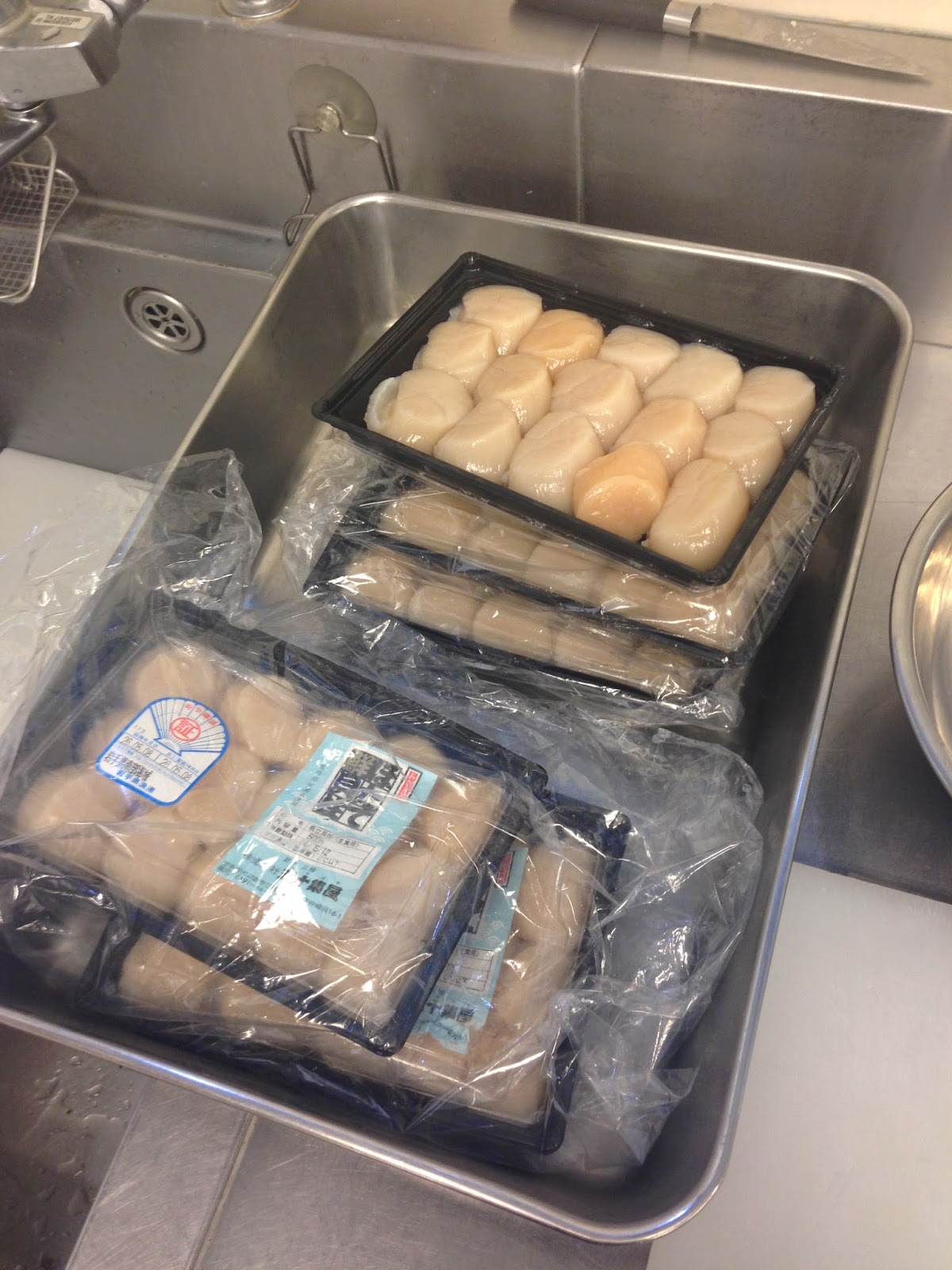
They trusted me to work with scallops one day.
Watching Japanese chefs work with fish is mesmerizing.
Making a raspberry mouse--gelatin comes in sheet form in Japan, not powder.
Stirring up the mousse!
Kaori, the pastry chef, measuring out bacon for a savory creme-brulee.
     The most unique experience I had in the kitchen happened at breakfast one morning. I was sitting down and they placed a styrofoam box next to me and told me to open it. Inside was a turtle crawling around. By lunchtime I had seen said turtle beheaded, gutted and its shell boiled to make a soup. Fun fact--turtles' heads can continue to move around for at least twenty minutes after it's been cut off. THANKS FOR READING!


Until next time, 
            Charlotte