Showing posts with label Missionary. Show all posts

Friday, May 23, 2014

Actually Using that Degree I Earned

     I have to admit when I applied to be a missionary, I thought my degree in event management and hospitality would just sit there and look nice in its frame on the wall. When that degree actually played a part in why I was placed in Japan, I was excited to see how I could apply my (expensive--Sorry Dad) knowledge I had gained in Florida.

     Over the last few months I have spent three days a week working at Seisen-Ryo, KEEP's hotel side of the operation. Seisen-Ryo was originally built in the 1930s as a leadership camp for young Japanese Christians to come and relax in the mountains. Today, it has evolved into a relaxing resort retreat that is well-known around Japan--mainly because of its association with the infamous soft cream. The whole Seisen-Ryo property is made up of the "Original Lodge"--built in 1957 after the first building burned down, the "New Annex" which was constructed in 2009, and then the surrounding Cottages. Guests can enjoy the old world charm of the Western and Japanese style rooms in the Original Lodge, the new amenities offered in the New Lodge's Western or Japanese style suites or stay in the Cottages in the woods with their larger groups (as you can tell, one of my jobs was to work on the wording for translated marketing materials).

     GM--our name for our general manager of Seisen-Ryo and the Paul Rusch Memorial Museum--had tasked me with working at the hotel at both the front desk and in the kitchen of the restaurant. I wasn't quite sure what I was going to be doing at first, all he told me was I was to be there to speak English with everyone and to get them accustomed to working with foreigners.

     My first task working at the front desk was to collaborate with Hoshii-san, my manager while there, to translate signs around the hotel. She has really great English, so she would tell me what the Japanese sign said and then I would translate it into native and natural English. She told me it was a task that they had been slowly working on over the last few years, but would just fall to the wayside as more important tasks arose. We went around the entire property and translated anything and everything we could find. There were signs warning of the slippery bridge ahead, giving guests directions on how to rent items, where people that aren't guests should please refrain from entering, where to wait in line for check-in/check-out, etc. That was the easy part, wherever there was a Japanese sign, we put it into English. The harder part was going through and deciding what needed to be explained to foreigners that Japanese people don't even think twice about. Hoshii-san had me stay in the hotel as a guest in the Japanese style room and really analyze what, as a foreign guest, I didn't understand. Just as an example, the idea of bathing in the hot springs is second nature to the Japanese, but as a timid foreign guest, the proper procedures are something that needed to be explained.
Just one example of the MANY translated signs around the hotel.
Working with guests at the front desk.
     After that big project was done, we moved on to creating an English handbook for the staff. Seisen-Ryo frequently gets inquiries from English speaking guests and sometimes things can get lost in translation. I created templates of emails that staff can just plug in the necessary information for any situation that a guest may present--emails about available dates, room styles, menu options at the restaurant, room packages, etc. Hoshii-san was also very interested in knowing how best to interact with guests in English--key hospitality phrases. I created a list of easy phrases that any of the staff could practice in their free-time. Things such as formal greetings, formally welcoming guests, asking how their stay was and inviting them to stay with us again. She was very interested in knowing words that would really polish their service standards--four years of being ingrained with that at UCF? I think I know a few words to help. Also, there are a lot of documents, ie. local train schedules, that are all in Japanese and confusing even if you do know Japanese, so I compiled train schedules of the local lines into an easy read English document that staff could easily hand to guests without much explanation. All of these documents were put into a nice little handbook. Over the past few months during the morning staff meetings, I had been updating everyone about what I would be working on that day. Everyone seemed very excited about eventually having that resource, so it was awesome when I finally got to distribute them to all the staff--my first finished project here! The guest rooms also now have completely translated information books for guests as well! Something I know I miss when I'm staying in Japanese hotels. One of my proudest moments so far has been staff telling me about Mika, one of the girls I work with that has limited English, and how she worked with a foreign guest and how great she did!
Hoshii-san also translated everything for the table of contents so everything is easily found!
English is so complicated when you sit down and think about it!
     On Fridays, I worked in the kitchen of the restaurant of the hotel. I had so much fun down there! I didn't really have any tasks besides just to socialize with everyone, but I hated just standing around, so I would always find something to do. I would arrive at nine, put dishes from the guests' breakfast into the washer and then it would be the staff breakfast time. We would eat as a group and that time was spent throwing dictionaries back and forth, using translator apps, learning new words, and essentially playing charades to communicate. It was good practice for me as well because a lot of people's English was about the same level as my Japanese. We would work until lunch--me mainly doing kitchen tasks that I couldn't screw up, like peeling potatoes or washing lettuce. This was another great opportunity for us to practice our vocabulary with each other, they would hand me something and say the Japanese name and I would tell them the English word--eggplant was the most confusing and hilarious to them. Having worked in restaurants with big kitchens and having culinary labs in college, I have to say not much is different in kitchens in Japan. A lot of things are French words, just like in the US, but I will say the head chef is not a scary as the ones in the States can be.
Plating dessert.
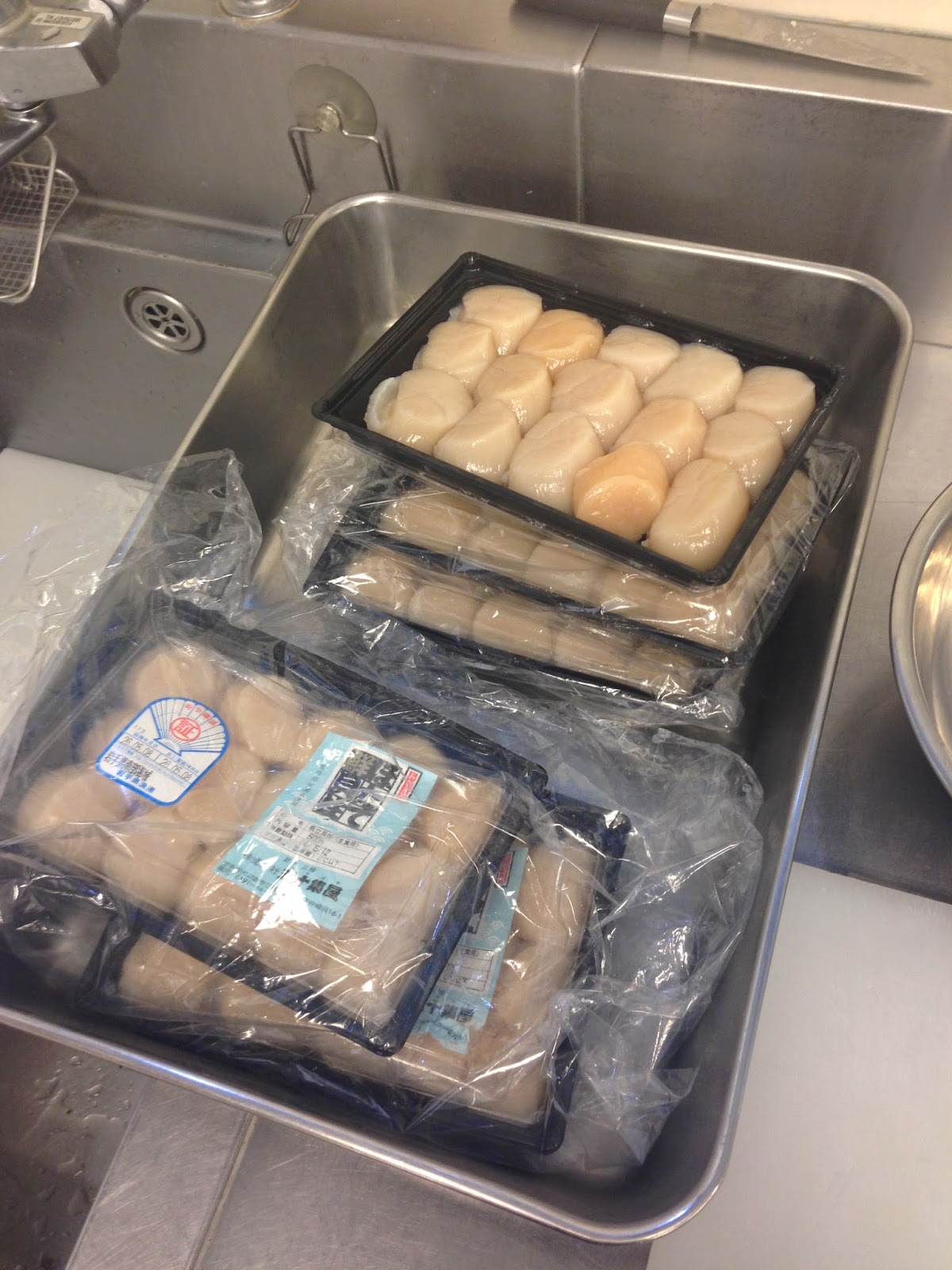
They trusted me to work with scallops one day.
Watching Japanese chefs work with fish is mesmerizing.
Making a raspberry mouse--gelatin comes in sheet form in Japan, not powder.
Stirring up the mousse!
Kaori, the pastry chef, measuring out bacon for a savory creme-brulee.
     The most unique experience I had in the kitchen happened at breakfast one morning. I was sitting down and they placed a styrofoam box next to me and told me to open it. Inside was a turtle crawling around. By lunchtime I had seen said turtle beheaded, gutted and its shell boiled to make a soup. Fun fact--turtles' heads can continue to move around for at least twenty minutes after it's been cut off. THANKS FOR READING!


Until next time, 
            Charlotte


Monday, March 31, 2014

A City Girl Learns About the Environment

         So since my last update, that didn't include me being in complete awe how much snow was dropped on this place, I was marking my first month here in Japan. Well when they tell you time flies, they are not kidding. My THREE month mark has come and gone. It is the weirdest feeling to talk to people and tell them I am here until January and they respond with "Oh so only for another nine months?" and I want to shake them and tell them "DON'T SAY THAT! I have so much time left!!!" But as they say, you blink and it's gone.

          As I said in the last blog post eons ago, I have been rotating around the different departments here at KEEP. The beginning of March brought my time with the Environmental Education department. This is the department I attended the event in Tokyo for back in January. Now that I celebrated its thirtieth anniversary, I was now going to see what they did on a day to day basis. The first day with them I was taken on one of the short nature tours they offer to guests coming to KEEP. The people that work for Environmental Education, or E.E., are very knowledgeable about what they are teaching. While there is that whole language barrier thing still, the hands on aspect of the program gave me an idea of what was being taught. There is a big trend right now in Japan, at least from what I can tell from the increasing amount of guests coming to KEEP, for "getting back to nature", so people come to learn about the trees, the animals, the plants and how they all interact and to basically become one with nature. After the first few days of learning about the E.E. department and exploring their awesome exhibit they have in their offices--seriously they have an area titled "Whose butt is this?" where you guess which animal rear end is sticking through the display, I was sent to work at Harris Hall.

One of the "nature interpreters", what they call a kind of nature guide, teaching a group that came in about the animals in the area.
Who's butt is this? Stick your head through and see!

More animals of the forest!
Identifying the different types of tree in the forest
     Harris Hall is the large conference hall in the woods amongst all the cabins. For the next three weeks I was going to be working with three different groups of college students coming to KEEP to learn about environmental education. Each session lasted three days and then we got a new crop of students in. The program was sponsored by the Tomodachi Initiative. Here is a description from their website


"In the aftermath of the Great East Japan Earthquake of March 11, 2011, the United States military and Japan Self-Defense Forces worked together successfully in Operation Tomodachi to provide immediate humanitarian relief to the Tohoku region. Building upon this cooperation and spirit of friendship, the United States and Japan launched the TOMODACHI Initiative. TOMODACHI is led by the United States Government and the U.S.-Japan Council, a tax-exempt non-profit organization, and is supported by the Government of Japan, corporations, organizations and individuals from the United States and Japan."

     I got to participate and be "the American perspective". The students that were there were studying some environmental issue in school and had some project that they were working on or had been apart of. The KEEP staff taught for a day and then the students broke into groups to present their individual projects to each other. On the last day, using what they had learned and each other's current projects as inspiration, the groups were then supposed to create their own environmental education based program that they then presented to the whole group--at least that is what I gathered from the whole process. The students were all really nice. There were a few in each session that spoke really good English, one girl I was even convinced was actually from the US, but really had just gone to an international school in Tokyo. Everyone was really eager to talk to me and practice their English. A lot of people had questions about what the US was like because they were either traveling there soon or were going to be studying abroad there. At each session they had "Charlotte Time" where I had to stand up and talk about myself and where I am from and then everyone got to throw out questions--of course most were environment related. Everyone who knows me knows that I am more of an indoor creature, so the fact that I was able to answer some of their questions with certainty was pretty amazing to me. A lot of the questions were like "How does America recycle?", "Why are there so many national parks out West?", "What is the government trying to do to help cut down on pollution created by businesses?"---these kids were very well informed on US issues and I was impressed. I now know I can perform well under pressure when faced with things I THOUGHT I had no idea about.

Classroom learning--what is environmental education & why is it important to bring it into the future?
Now talking about what is happening in their area of Japan in relation to environmental education.
Out of the classroom--hands on learning.
Visit to the KEEP Dairy Barn.
More tree identification!
It was a little hard to learn when you were frozen--but the students were troopers!
Nature scavenger hunt.
During this session, we were split into groups to work together to create things from our environment--we made a snow samurai!
Snow angel time!
During another session--we created "artwork" from nature--I felt bad every time someone got paired up with me, but people were good sports.
After a morning of subzero outdoor classroom learning it was time to retreat to the "kotatsu" which is one of the greatest inventions ever--it is a table that has a heater underneath and blankets attached to the side to keep the heat in.
Each student presenting the work they have been doing with their  respective colleges or organizations. After, they combined their previous work and created a new environmental education program to present to the larger group.
Each small group presented their ideas to the larger group.
After the explanation of the programs, everyone went around and judged what they thought were strengths and weaknesses of everyone else's group ideas.
Blue--strengths, pink weaknesses
After everyone went through and dissected everyone else's idea, they judged whose program would theoretically be most successful. The winning group received a KEEP Environmental Education prize and a coupon for FREE SOFT CREAM! That was a huge hit. This was the winning group from the first session.
Winning group from the second session!
Winning group from the third session!
We ate all meals together which was a great time to get to know all the students. They loved asking questions about America and what American college students were like.
All of us practicing for our "night hike". We look these insulated yoga mat type things out to lay in the three feet of snow to look at the stars and "be one with nature"--still one of my favorite things I have done since being at KEEP.
My new friend Rika--she had great English. She had spent a semester in Australia. She thought it was so funny that I could detect an Australian accent in her English.

          On days I'm not working with these groups, I have been continuing my work at the Paul Rusch Memorial Museum, no longer Center. We had a name change at the beginning of the fiscal year on April 1. I am still working on archiving and creating the searchable database of the Paul Rusch letters. I just finished the Eli Lilly Fund folder and was interesting to see how the Lilly Endowment was broken down in his will and seeing names of places that I actually knew! KEEP was among some big Indy names like the IMA and Children's Museum that received money. The money KEEP received was in memory of his wife. Seeing all of that was a nice reminder of home.
I KNOW THESE NAMES AND PLACES!
          So now that catches us up to pretty much today. I now have a set schedule here at KEEP, Mondays and Thursdays are spent at the Paul Rusch Memorial Museum, and the weekends I am at the hotel here, Seisen-Ryo. Fridays I am working in the restaurant of the hotel and Saturdays and Sundays I am working in the front office and front desk area. I've only been here a few days, so I don't have much to report back yet or any pictures, but my main job here is going to be teaching about the American service industry and translating signs in to native English as well as learning the systems and how things are done here. I am already having so much fun being back in the hospitality field and now adding the international aspect into it is really exciting. I'll update when I have more information and pictures.

          So again I apologize for the delay in blog postings. Hopefully now that things here are picking up and I'm not snowed in anymore, I will have more to report on. Spring has finally started here in the mountains! The snow is (almost) completely gone and the flowers are blooming. Luckily I didn't miss the sakuras, or cherry blossoms, blooming up here in the mountains. They say Kiyosato sakura season is about a two or three weeks behind Tokyo, where the blossoms are said to have already fallen. I hope every has had a great Holy Week and a fantastic Easter this weekend. Thank you for sticking it out for another long post!

             Until next time,
                               Charlotte


Wednesday, March 5, 2014

Lenten Meditations


Not much has been happening here in Kiyosato to update on. We did just receive enough snow again yesterday to cancel Ash Wednesday services so that was kind of a let down. I was nervous about my car getting stuck...again, so I decided to walk to church. Bad idea because I didn't find out until I got down there that the services were cancelled. It afforded me some much needed exercise, the thirty minutes down and thirty minutes back up. Anyways, now that the Lenten season is upon us, our group of YASC volunteers has set up a blog, Meditations from Millennial Missionaries ,where we will post these Lenten reflections. Take a look at the second post from Ash Wednesdays around the world. There are a few pictures of my church, St. Andrew's, under the snow. I've also created a link on my blog in the menu for easy access. Look out for my reflections on March 18 and April 9!


Thursday, February 20, 2014

Winter is Coming? It 's here.

     I apologize for the bad Game of Thrones joke, but I can't help but think I'm north of the wall and am going to see a white walker when I look out the window. As some of you have told me via Facebook, the news of the record breaking snow in Japan has made it to the U.S. which is a big deal. Here, it's not unusual for the Japanese to be extremely aware of U.S. news and policies (I've had discussions started by my coworkers asking about how many states gay marriage and marijuana are now legal in). I couldn't even begin to speak about what are the big issues in Japan, besides the snow, and I'm living here! To put you all at ease, I am doing perfectly fine. I haven't lost heat or power despite Mother Nature giving it her best attempt, as you tell from this article from Reuters and this article from The Japan Times. If you remember from a few posts ago Kiyosato is in the Yamanashi Prefecture, capital Kofu, which are both the focus of the articles. The amount of snow, 114 centimeters, closed KEEP. Most all of the offices closed on Friday when the storm hit and today was the first day a few of the offices reopened. So what has that meant for me? Well after finishing up my time at Shizen Gakko last Tuesday, I had three days off before I was supposed to go back on Saturday. Obviously, programs were cancelled due to weather, so there was no one to cook for, so I've been hanging out in my dorm for the past nine, NINE! days. I've gotten really into watching West Wing online. I did make it out to the 7-11 to get more food and it looked like the apocalypse had hit. All the bread and cereal AND cookies were gone along with most everything else on the shelves.The creepiness was taken to another level when the only other person in the store at 9:30pm with me was the store clerk who had a face mask on. While I know it's a polite thing to wear when you're sick, it just made me feel like I was in the middle of a zombie outbreak. Yesterday I couldn't really handle the cabin fever that was setting in anymore, so I bundled up, grabbed my camera and headed out around KEEP and walked down into Kiyosato itself to check out the storm damage. It's mostly pictures because talking about how many times I've painted my nails or done pilates in my room can get a little boring.


The path from the front door towards the bigger path that leads to the main road.


I totally understand how these things can kill you!


The path that's usually a road to drive to our dorm.


Looking from the road, over what is usually a parking lot to the restaurant of the Siesen Ryo Annex.
Climbed on top of a 7 foot snow pile to look out over the usual parking lot.


Because we're in the mountains, the wind whips around and creates these HUGE snow dunes.
Street sign that's about the height of a US speed limit sign.


Not quite sure of the type of bird--I'm not well versed in Japanese fowl yet, I apologize.


I should have know I was gonna see some wild life.


I believe the bakery has been open the whole time because I've 
heard my roommate get up every morning for 
her 4am shift-it's those West Wing binges.


More killer icicles that haven't been ripped off the roof by a nervous American.


The sign for church.

I now know the hill to church is do-able.


I may be able to get TO church, but whether or not I'll be able to get IN is another story.
Crossing over the railroad tracks walking into town.

While the town is pretty dead in the winter with most of the shops closed, the snow makes it even eerier. 

I'm really excited for summer to come so I can go to the Milk Pot...
who wouldn't want to go 
somewhere that's shaped like a tea pot?
A TEAPOT!


My favorite building besides the Milk Pot--the Green Prah. Have yet to figure out what it is.

We have one police car in Kiyosato. It will make it much easier to creep when I hear sirens.

Hill leading up to the train station. 
Truck taking away plowed snow...to where? I never found out.

Decorative train engine, but it gives you a scale of the snow amount.

What's normally, I would assume, a picturesque, lush, verdant area in front of
the train station. I wouldn't know it's
been covered with snow since I got here.  
Looking down the road through town that leads to KEEP.

Headed back up the hill...clock tower next to the Milk Pot.

The mountains over KEEP...it never gets old.

On the way back they had brought out the snow plow train.

Looking out over the mountains to the south.

I found someone's polar bear that escaped to his natural habitat.

The field where County Fair is usually held.

Three days ago every single one of those cars was covered in snow to their roof.
I don't know who did it, but they
 deserve my first born.

The path back to Lancaster.

I went out again today anticipating exploring up the mountain, but after I started and the road became not as cleared, the warning from my manager in an email saying "Don't go anywhere in the snow without staff" started repeating in my head. I decided to just hang around the rotary by the old Seisen Ryo building and watch the sun start to set. It's my favorite part of the day with the sun going down over the mountains. I climbed a huge snow pile and just sat and watched. 

The old Seisen Ryo lodge with the Paul Rusch statue. 

The Paul Rusch statue in the middle of the rotary.

View from atop my perch.

This couple tried to make their poor dog walk in the snow. It didn't work so well.

View of the Jersey Hut where they sell the famous soft cream.

Just wanted to send a post out to show I'm alive and well even in the heaviest hit area of Japan. 

Until next time,

Charlotte